Thursday, June 4, 2009

Africa Doesn't Need Aid, It Needs Good PR

I spoke on the phone this afternoon with Dr. Leslye Obiora, a dear mentor of mine from Yale who served as Nigeria's Minister of Mines and Steel Development from 2006 - 2007, directed the World Bank's (don't worry!) program for Women and Law, and has also founded the Institute for Research on African Women, Children and Culture (IRAWCC).  We'll be collaborating this summer on a piece centered on aid effectiveness, along with Dr. Alfred Monye of Nigeria's National Planning Commission.  She alerted me she recently wrote an article for The Christian Science Monitor, published on May 20.  After five seconds of Google-ing, I came across her phenomenal article, which calls for the international community to view Africa (and Nigeria specifically) as a much more than a land of corrupt scam artists, but rather, as a land where a largely ethical and hardworking population must remain resilient in the face of the greed of a few in power.  Indeed, a reading of Karl Maier's work on Nigerian history un-optimistically entitled This House Has Fallen: Nigeria in Crisis emphasizes that the wider global community is affected by Nigeria precisely because the so-called "419" internet scams "have become the number three form of internet fraud." Rather, I would argue that the Nigerian crisis touches us at a more profound, more humanistic level. That Nigerians must resort to these tactics for capital accumulation is not endemic to their character: the nature of the global political economy has left little other resort. Perhaps more appropriately Africa needs to launch a PR campaign against the unsavory tactics of the West. 

De-Colonization Continues: Guadeloupe Calls for Independence from France


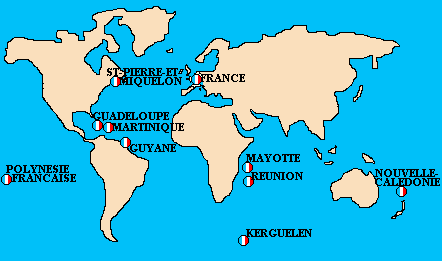
Since having worked for the French Government as an English Assistant in Cayenne, French Guiana in 2006 - 2007, I've been conducting an ongoing (and at present, greatly stalled) project examining the French DOM-TOMs and their prospects from independence from France. Essentially, the DOM-TOMs (Domaines d'outre mer and territoires d'outre mer) are various islands (and in the case of French Guiana, mainland territories) that are bits of the former French empire that have yet to be officially de-colonized.  They may be said to be analogous to Alaska and Hawai'i - non-contiguous extensions of a more powerful central state.  
The resemblance to colonies of days gone by should not go unnoticed. Inequity in French Guiana is highly drawn along racial lines, with the Creole, Hmong and indigenous Amer-Indian populations living on a fraction of the resources enjoyed by the ever-rotating cadre of French civil servants (highly reminiscent of former French colonial bureaucracy) that rotate in and out every few years.  The call today by Guadeloupe's Communist Party (GCP) to support its independence from France is a highly heartening step in the right direction, as were the 2008 protests that took place in another French Caribbean DOM-TOM, Martinique.  The move for self-determination for these neo-colonies is a highly important step in achieving a de-colonization process largely (and incorrectly) assumed to be complete. 

China: The New IMF for Africa?

After returning back to my home of Hendersonville, nestled in the Appalachian mountains of Western North Carolina, I became acutely aware of the extent to which discussion on the "New Scramble for Africa" has permeated not only academic circles, but civilian discourse as well.   For those who aren't well-versed in the discussion, a recent article by Lord Aikins Aduesi written for the exceptional Pambazuka News Agency succeeds in outlining the broad contours of the argument.  Though he offers very little new insight into the general discussion of the topic of neo-imperialism in Africa, he does arrive at an interesting conclusion: that with the ascendence of China, Africa now has an alternative outlet to receive funding for development projects that will allow it to avoid its historically disastrous relationship with the IMF and World Bank.  While I wholeheartedly agree that the democratization of the development arena is a positive,  I recall an essay written by a colleague of mine at Yale by the name Channa Cummings, which questioned the extent to which China has become the "new IMF" for African countries. 

Dr. Paul Tiyambe Zeleza to Serve as Dean of College of Liberal Arts at Loyola-Marymount

Dr. Paul Tiyambe Zeleza, who has been kind enough to conduct interviews with me both for Washington DC's 89.3 "AfricaNow!" radio program and for the Fall 2008 edition of the Yale Journal of International Affairs, has recently been named the Dean of the College of Liberal Arts at Loyola-Marymount University.  Dr. Zeleza has been the President of the African Studies Association and also won the 1994 Noma Award (designating the best book from Africa) for his work "An Economic History of Africa."  Sincere congratulations Dr. Zeleza. 

A Culture of Corruption: Everyday Deception and Popular Discontent in Nigeria by Daniel Jordan Smith

This summer I'll be working at the United Nations Development Program in Abuja, Nigeria.  Specifically, I'll be in the Governance Unit, which seeks to encourage democratic practices, discourage corruption and strengthen a commitment to human rights. In preparation, I recently purchased the book A Culture of Corruption: Everyday Deception and Popular Discontent in Nigeria by Dr. Daniel Jordan Smith of Brown University from Barnes and Noble.com.  Upon opening the book, the title page read When They Severed Earth From Sky and the following pages included chapters entitled "Willfulness: The Atom or Thou" and "Post Hocus Ergo Pocus: Space Aliens Mutilate Cows." Apparently, Princeton University Press made a pretty serious blunder here...

Samasource: Innovation in Social Entrepreneurship


A student in a class that I  TA'd at Yale this Spring, called "African Poverty and Western Aid" (taught by Dr. Chris Blattman) has brought to my attention the highly creative work being done by a group called Samasource.  Founded by a Harvard graduate with a specialty in African Development Studies (can one major in such a thing?!) Samasource seeks to outsource internet-based tasks - like data entry, website design, etc. - to people in developing countries who otherwise remain excluded from participation in the global political economy.  Contact me for more details.... 

Op-Ed from Zimbabwe

Another characteristically anti-imperialist op-ed from Zimbabwe's state-run newspaper, the Herald.  I'm a particular fan of this one, primarily because North Carolina's Jesse Helms gets bashed on by a Zimbabwean journalist.  We didn't think so highly of him either, Mukanya...